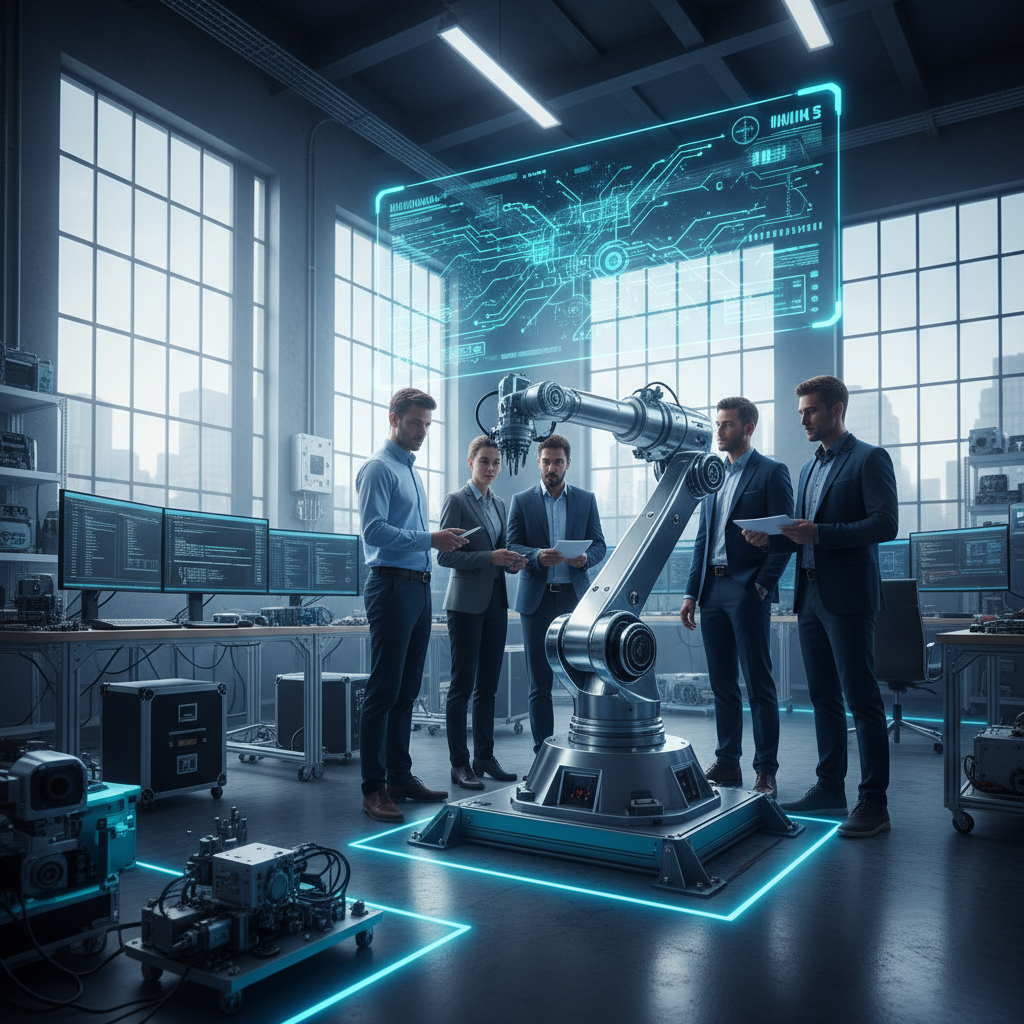
Deep Tech
Physical AI: The Founder’s Guide to Building in the Real World

For the past decade, the center of gravity in artificial intelligence has been digital. Natural language processing, generative media, and recommendation engines have scaled within the clean confines of cloud servers and web interfaces. In these environments, edge cases are forgiving: a hallucinated paragraph or an irrelevant search result can be corrected with a click.
That dynamic is changing rapidly. We are entering the era of physical AI—embodied intelligence where software interacts directly with the laws of physics, material surfaces, and dynamic environments. From autonomous mobile robots in warehouses to automated surgical instruments and advanced agricultural machinery, intelligence is moving into atoms.
For entrepreneurs, building in the physical domain presents an entirely different set of operational, economic, and technical challenges. Unlike pure software, physics does not offer rollbacks. Compute is constrained by battery life and thermal envelopes, safety tolerances are absolute, and unit economics are tied to real-world bill-of-materials (BOM) costs.
Below is an actionable guide for technical founders stepping into physical AI, covering foundational architecture, common pitfalls, and tactical moves you can make this week.
Understanding the Physical AI Architecture
To build a defensible physical AI company, founders must look past the buzz of generalized humanoid robotics and recognize what physical AI fundamentally represents: a closed perception-action loop running in dynamic physical systems.
Traditional robotics relied on deterministic, pre-programmed kinematics: if coordinate X is reached, move arm to coordinate Y. Physical AI replaces brittle hard-coded routines with probabilistic, learning-based systems capable of adapting to unstructured environments.
Successful physical AI ventures structure their architecture into three decoupled yet synchronized layers:
- The Sensor and Spatial Foundation: Modern physical AI moves beyond single-stream vision. It leverages spatial computing, multimodal sensor fusion (RGB-D cameras, LiDAR, tactile sensors, and IMUs), and fast on-device inference to build dynamic 3D representations of the immediate world.
- The World Model and Reasoning Engine: Rather than predicting the next token in a sentence, physical AI models predict the next state of a physical system. This requires an understanding of intuitive physics—mass, friction, occlusions, and elasticity—enabling the system to plan actions over multi-step horizons.
- The Control and Actuation Layer: High-level reasoning must translate into low-level joint torques, velocity profiles, and mechanical adjustments in milliseconds. Latency here is critical; a 100-millisecond delay in physical execution can mean the difference between grasping an object cleanly and damaging expensive machinery.
The Reality Gap: 4 Critical Mistakes Early Teams Make
Transitioning from academic research or pure digital machine learning to embodied systems frequently exposes several predictable failure modes. Understanding these mistakes early preserves both runway and credibility.
1. Over-Indexing on Pure Simulation (Sim-to-Real Failure)
Simulation platforms like NVIDIA Isaac Sim, MuJoCo, and Unity are indispensable for generating synthetic training data at scale. However, founders often believe that achieving a 99% success rate in simulation equates to readiness for deployment. In reality, simulators cannot fully replicate micro-vibrations, lens flare, sensor noise, contact friction variations, or thermal drift. If your transfer pipeline lacks domain randomization and real-world calibration, your models will degrade immediately in the wild.
2. Premature Hardware Customization
Too many early-stage physical AI founders attempt to build bespoke mechanical hardware before they have established software product-market fit. Designing custom chassis, actuators, and sensor housings drains capital and extends iteration cycles from days to months. In the early stages, your core value proposition is your intelligence layer, not custom sheet metal.
3. Ignoring Edge Latency and Thermal Budgets
Running multi-billion parameter vision-language-action (VLA) models in a controlled cloud testing environment is straightforward. Running them autonomously on a moving platform with a 45-watt power budget, passive cooling, and unreliable network connectivity is profoundly difficult. Failing to architect for on-device quantization, distillation, and hybrid edge-cloud orchestration early leads to severe redesigns later.
4. Underestimating Edge Cases in Unstructured Environments
In software, a 95% benchmark accuracy is often adequate for an enterprise pilot. In physical robotics, a 5% error rate means a failure every twenty operations. If an industrial arm operates every 10 seconds, that equates to dozens of interventions, damaged goods, or line shutdowns every single day. Physical systems require operational reliability measured in nines.
An Operational Framework: The Real-World Deployment Matrix
To navigate these realities, founders should deploy the Real-World Deployment Matrix (RWDM)—a framework designed to balance technological ambition with commercial viability.
Phase 1: Constrained Domain (Strict ODD) -> Zero custom hardware -> High human-in-the-loop Phase 2: Semi-Structured Environments -> Optimized sensor packages -> Remote exception handling Phase 3: Fully Autonomous Execution -> Edge-native models -> Resilient multi-agent coordination
Step 1: Constrain the Operational Design Domain (ODD)
Define the exact operational boundaries where your system operates. What are the lux levels? What is the floor gradient? What is the maximum humidity? What types of objects will the system interact with? By aggressively constraining your initial ODD, you reduce physical entropy, accelerate commercial validation, and generate immediate customer ROI.
Step 2: Build a Closed Data Engine
Your true competitive moat is not your initial model architecture; it is the proprietary data engine you establish. Every physical deployment must serve as a data ingestion node:
- Automatically capture failure states and high-uncertainty events.
- Pipe edge anomalies back into your simulation environment.
- Generate synthetic variations around edge cases to retrain models continuously.
Step 3: Implement Human-in-the-Loop Teleoperation
Do not wait for full autonomy to start generating revenue. Deploy systems with integrated teleoperation fallbacks. When the model’s confidence drops below a defined safety threshold, a human operator can remotely assist or resolve the edge case. This maintains uptime for the customer while yielding high-value demonstrations for supervised fine-tuning.
What Founders Can Execute This Week: Actionable Next Steps
If you are leading or advising a team building in physical AI, use the following tactical recommendations to sharpen your operational focus this week.
- Define and Document Your Operational Design Domain (ODD): Gather your engineering and commercial leads. Explicitly document every physical variable your system will support—and more importantly, what it will explicitly reject. Use this boundary document to align customer contracts and test suites.
- Audit Your Sim-to-Real Transfer Ratio: Measure the performance divergence between your simulation benchmarks and physical lab prototypes. If the delta is greater than 15%, halt simulation expansion and focus immediately on sensor noise modeling, domain randomization, and real-world calibration sets.
- Commoditize Your Hardware Supply Chain: Review your current BOM. Replace any custom-machined or proprietary component with off-the-shelf alternatives unless that custom component directly unlocks your primary algorithmic advantage.
- Instrument High-Uncertainty Logging: Ensure your robotic runtimes flag and save 5-second video and telemetry snippets whenever model confidence drops below baseline. This forms the backbone of your data engine.
- Evaluate Model Compression Techniques: Benchmark your current neural architectures using INT8 quantization, layer pruning, and knowledge distillation on your target edge compute modules (such as NVIDIA Jetson systems). Determine your actual latency, wattage, and thermal ceilings under sustained load.
The Commercial Horizon of Embodied Systems
Physical AI is not simply an extension of software as a service; it represents an industrial paradigm shift. Moving from digital recommendations to direct physical work touches manufacturing, logistics, supply chain resilience, construction, and healthcare.
Founders who succeed in this domain will be those who balance grand architectural ambition with rigorous engineering discipline. By respecting physics, prioritizing robust data engines over premature hardware customization, and systematically expanding their operational domains, deep tech entrepreneurs have the opportunity to build the enduring industrial giants of the next half-century.
How Synapses Ventures Can Help
Turning breakthroughs in physical AI and robotics into viable, enterprise-grade companies requires more than standard venture funding. It requires deep technical grounding, access to specialized compute and testing infrastructure, and direct pathways to industrial commercialization.
Synapses Ventures partners with technical founders, researchers, and engineers from day zero to navigate the complexities of building in the physical world. Through our venture building platform, we provide:
- Deep Technical and Architectural Guidance: Supporting teams across edge-AI optimization, spatial perception pipelines, sim-to-real workflows, and safety verification systems.
- Commercialization and Pilot Validation: Connecting founders directly with enterprise partners in logistics, advanced manufacturing, and healthcare to deploy and validate physical systems within real-world environments.
- Supply Chain and Hardware Ecosystem Access: Helping teams source reliable off-the-shelf components, optimize BOM costs, and scale manufacturing without premature capital expenditure.
- Strategic Capital and Global Networks: Providing foundational capital and co-investor syndication tailored specifically to the milestones and capital cycles of deep technology ventures.
If you are building transformative systems at the intersection of intelligence and physical reality, explore how Synapses Ventures can support your journey from prototype to market leadership.
Share this article
Physical AI: The Founder’s Guide to Building in the Real World

As artificial intelligence steps beyond digital interfaces, physical AI represents the next massive frontier of enterprise value creation.

Inside the piece:
• What actually moves the needle for early-stage founders
• How we apply it across the Synapses venture portfolio
• The practical next step you can take this week

Read the full article → https://synapsesventures.com/s/physical-ai-founders-guide

#SynapsesVentures #DeepTech #FrontierTech #RnD