
Artificial Intelligence
Physical AI: The Founder's Guide to Embodied Intelligence
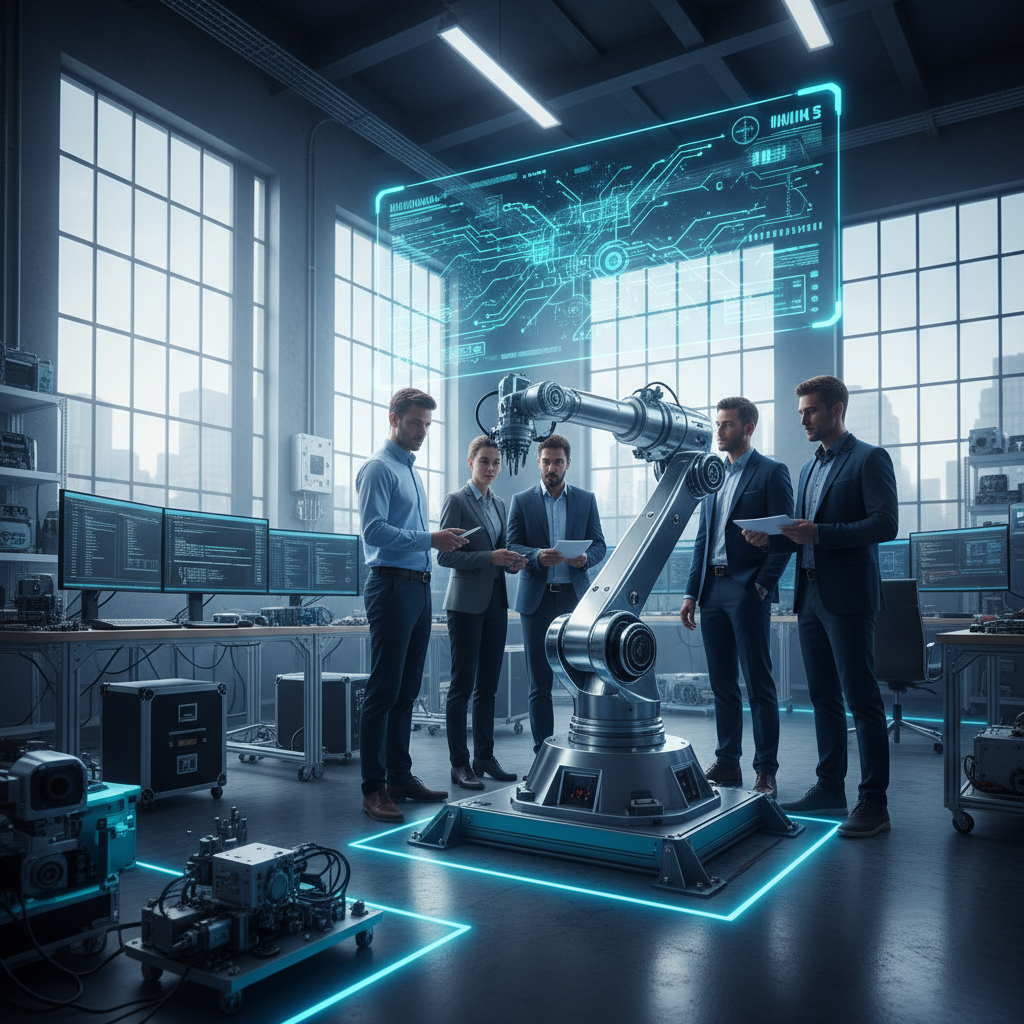
For the past decade, artificial intelligence has lived almost entirely behind glass. Software engineers trained transformer architectures on digital text, generated synthetic images, and automated knowledge workflows across cloud environments. These digital foundation models have reached extraordinary scale, yet they remain fundamentally detached from physical reality. They do not experience gravity, friction, thermal limits, or mechanical wear.
That boundary is now dissolving. Physical AI—often referred to as embodied intelligence—represents the convergence of advanced perception, spatial reasoning models, and physical actuators. Instead of simply generating responses to user prompts, Physical AI systems perceive their dynamic environments, execute reasoning across physical constraints, and safely perform tasks in the material world.
For founders, transitioning from digital software to Physical AI introduces unprecedented technological and operational complexities. Moving from bits to atoms alters unit economics, development velocity, and system failure modes. Below is a strategic and practical guide to navigating the design, development, and commercialization of Physical AI ventures.
Moving from Digital Logic to Physical Reality
Traditional artificial intelligence operates in structured, deterministic data environments where an error results in a software exception or an incorrect text completion. In contrast, Physical AI operates within open-world environments characterized by non-deterministic physics, unstructured terrain, and unpredictable human interactions.
A complete Physical AI stack requires three tightly integrated layers:
- Multimodal Spatial Perception: Translating raw high-frequency sensor streams—such as LiDAR, RGB-D cameras, tactile sensors, and inertial measurement units (IMUs)—into coherent, real-time spatial representations.
- Embodied Cognition and Policy Generation: Utilizing Vision-Language-Action (VLA) models or reinforcement learning policies that ingest multimodal spatial data and generate valid physical trajectories.
- Deterministic Actuation and Control: Translating high-level policy actions into low-latency, closed-loop motor commands that respect torque, velocity, and thermal thresholds.
Founders frequently stumble by treating these three layers as independent systems. In embodied AI, software cannot be isolated from hardware. The mechanical tolerances of an actuator directly constrain the inference latency budget of your edge model. True defensibility in Physical AI comes from optimizing across this entire stack rather than relying purely on proprietary model weights.
The Minimum Viable Embodiment: Avoiding the Humanoid Trap
A common strategic mistake among early-stage deep tech founders is succumbing to premature generalism. The visual appeal of general-purpose humanoid robots often distracts from near-term economic utility. Designing a humanoid requires solving dozens of unproven mechanical, battery, and dynamic balancing problems simultaneously before delivering measurable commercial value.
Instead, successful ventures prioritize the Minimum Viable Embodiment (MVE).
An MVE is the simplest mechanical form factor capable of collecting high-quality training data and solving an expensive physical problem. Consider these pragmatic design choices:
- Constrained Degrees of Freedom: If a task can be accomplished with a fixed-base 6-axis robotic arm on a mobile wheeled base, do not build a bipedal platform. Every additional degree of freedom increases operational failure rates exponentially.
- Task-Specific End Effectors: General-purpose multi-fingered hands are exceptionally difficult to calibrate and maintain in production. Specialized grippers—such as suction systems, soft robotic fingers, or task-tuned pinches—reduce model complexity while improving grasp reliability.
- Commercially Available Componentry: Build early prototypes using standardized, off-the-shelf actuators, compute modules, and sensor rigs. Custom silicon and bespoke motor winding should only be pursued when standard components mathematically prevent you from solving your customer's problem.
By focusing on an MVE, founders can compress the hardware development cycle from years to quarters, deploy into customer environments faster, and establish closed-loop operational workflows.
Overcoming the Physical Data Bottleneck
In standard natural language processing or computer vision, developers leverage vast datasets scraped from the public internet. In Physical AI, public datasets for high-torque manipulation, dynamic contact mechanics, and variable industrial tasks are virtually non-existent. You cannot scrape physical interaction data from the web.
To construct an enduring data moat, founders must implement a dual data-generation pipeline combining real-world teleoperation with high-fidelity physics simulation.
1. Teleoperation and Demonstration Capture
High-quality real-world data remains the gold standard for robotic learning. Founders should design streamlined, intuitive teleoperation rigs using VR controllers or kinesthetic demonstration interfaces. Collecting 500 to 1,000 pristine demonstrations of a specific physical task provides the initial ground truth required for behavioral cloning and policy initialization.
2. Sim-to-Real Transfer and Domain Randomization
Because collecting physical data is slow and expensive, simulation platforms—such as NVIDIA Isaac Sim or open-source equivalents—are indispensable. The challenge lies in the "reality gap": policies that achieve a 99% success rate in simulation frequently fail in the physical world due to unmodeled friction, lighting variations, and sensor noise.
To bridge this gap successfully:
- Apply Extreme Domain Randomization: Randomize friction coefficients, surface textures, object masses, center of gravity, camera positions, and lighting across millions of simulated training episodes.
- Inject Real Sensor Artifacts: Intentionally introduce latency, frame drops, and camera sensor noise into the simulation environment to force the policy to learn robust, fault-tolerant recovery behaviors.
- Implement Closed-Loop Validation: Continuously run physical validation tests alongside simulation runs. Measure the discrepancy between simulated predictions and physical outcomes to fine-tune your simulation's physical parameters.
Four Decisions Founders Must Make This Week
If you are building or pivoting into Physical AI, theoretical discussions must yield to operational decisions. Here are four concrete architectural choices your engineering team should finalize immediately:
1. Define Your Latency Budget Across the Stack
Physical stability demands deterministic response cycles. Establish strict timing boundaries between your high-level cognitive planner and your low-level controller:
- High-Level VLA Planner: Operating at 1 Hz to 5 Hz for environmental understanding and sequence planning.
- Mid-Level Trajectory Generator: Operating at 20 Hz to 50 Hz for obstacle avoidance and kinematic adjustments.
- Low-Level Motor Control Loop: Operating at 500 Hz to 1,000 Hz for torque regulation and balance.
Never allow an asynchronous network call or an unpredictable cloud-based model to sit inside your low-level control loop. If communication drops, the robot must gracefully and deterministically execute a safe halt.
2. Establish Safety Envelopes Using Deterministic Guards
Probabilistic models hallucinate. While a hallucinated sentence in a chatbot is an inconvenience, a hallucinated motion trajectory in an industrial environment can cause structural damage or human injury.
Implement hybrid safety architectures where learning-based policies propose movements, but deterministic, mathematically proven safety controllers validate and clamp those movements against predefined physical boundaries before any signal reaches the motor drives.
3. Implement Strict Sensor Redundancy and Degradation Protocols
Real-world operating environments are filled with dust, steam, vibration, and unexpected occlusions. Document exactly how your system behaves when an optical camera is blinded by glare, or an ultrasonic sensor experiences acoustic interference. Your system must support graceful degradation—slowing down or alerting human operators rather than failing catastrophically.
4. Calculate True Operating Unit Economics Early
Do not model your financial projections purely on software margins. A Physical AI business must account for physical realities:
- Mean Time Between Failures (MTBF) of mechanical components.
- Field service dispatch costs for physical maintenance.
- Thermal management costs under sustained computational loads.
- Power consumption limits relative to battery mass and charging cycles.
Common Pitfalls in Physical AI Startups
Understanding where previous deep tech ventures encountered friction allows current founders to preserve both capital and momentum.
- Mistaking Simulation Success for Deployment Readiness: Achieving strong performance metrics inside a digital physics engine is an initial milestone, not a finished product. Real environments feature ambient vibrations, uncalibrated lighting, and unexpected tactile resistances that simulations rarely capture out of the box.
- Over-Engineering Hardware Before Finding Problem-Market Fit: Spending millions developing custom aluminum chassis or proprietary gearboxes before confirming that customers will integrate your robot into their existing workflow is a critical misallocation of capital.
- Ignoring Edge Compute Constraints: Designing massive multimodal policies that require rack-mounted server clusters with multi-kilowatt power draws will restrict deployment to environments with stationary infrastructure. Prioritize model quantization and distillation for embedded edge chips from day one.
- Underestimating Deployment and Integration Friction: An enterprise customer will rarely adapt their operational layout to accommodate your robot. Your machine must fit into existing doors, integrate with legacy warehouse management software, and operate alongside existing human personnel without extensive retraining.
Summary of Key Takeaways
- Physical AI bridges bits and atoms: It combines multimodal spatial perception, embodied reasoning models, and deterministic actuation into a unified feedback loop.
- Prioritize the Minimum Viable Embodiment (MVE): Avoid premature humanoid designs. Target narrow, high-value commercial problems with the simplest mechanical structure possible.
- Build a hybrid data engine: Combine precise real-world teleoperation with heavily randomized physics simulations to overcome physical data scarcity.
- Decouple safety from machine learning: Use deterministic safety cages and low-level controllers to validate and gate probabilistic neural network outputs.
- Factor in physical realities: Include mechanical wear, thermal dissipation, on-device compute limits, and field support into your unit economics from the outset.
How Synapses Ventures Can Help
At Synapses Ventures, we believe that the next generation of foundational enterprise value will be built by companies that successfully bridge digital software intelligence with physical execution. Transforming breakthrough research in spatial computing, edge AI, and robotics into enduring, scalable companies requires more than just capital—it demands deep structural alignment across hardware engineering, software architecture, and commercialization.
We partner with visionary founders, academic researchers, and engineers at the earliest stages of their journey. Through our venture building platform, we provide hands-on strategic guidance, technical co-design support, industrial commercialization frameworks, and direct access to global manufacturing networks and enterprise design partners.
Whether you are commercializing novel lab-proven manipulation algorithms or building your Minimum Viable Embodiment to solve industrial-scale problems, Synapses Ventures acts as an active, aligned partner to help you build transformative companies from the ground up.
Share this article
Physical AI: The Founder's Guide to Embodied Intelligence

Physical AI represents the transition of artificial intelligence from digital interfaces into machines that perceive, reason, and act within our physical environment.

Inside the piece:
• What actually moves the needle for early-stage founders
• How we apply it across the Synapses venture portfolio
• The practical next step you can take this week

Read the full article → https://synapsesventures.com/s/physical-ai-founders-guide-embodied-intelligence

#SynapsesVentures #StartupInsights #VentureCapital #Innovation