Deep Tech
Physical AI: Bridging Foundation Models and the Real World
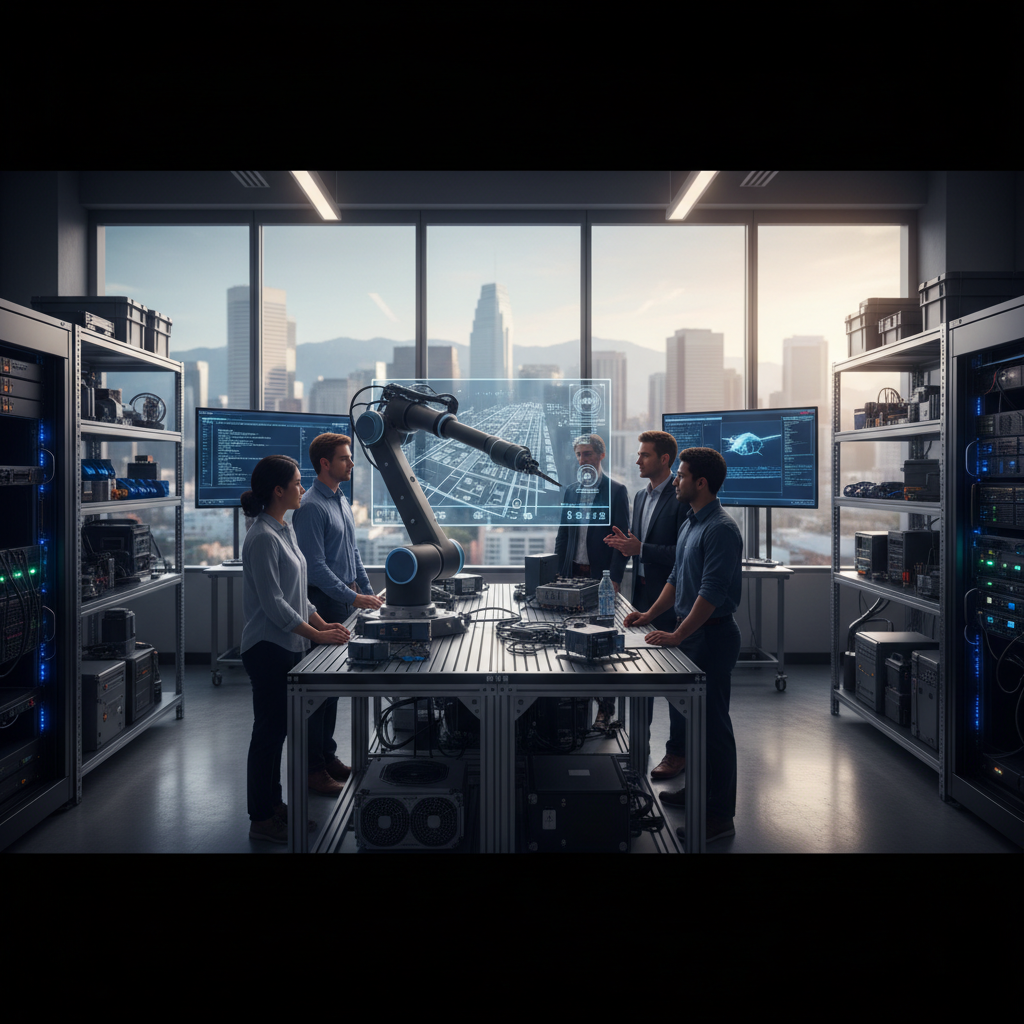
For the past decade, artificial intelligence has lived largely behind glass. Algorithms categorized text, generated images, predicted churn, and surfaced recommendations across flat digital interfaces. While the economic value generated by pure software AI is profound, software represents only a fraction of global economic activity. The majority of the world's GDP remains anchored in physical reality: agriculture, manufacturing, logistics, construction, energy, and healthcare delivery.
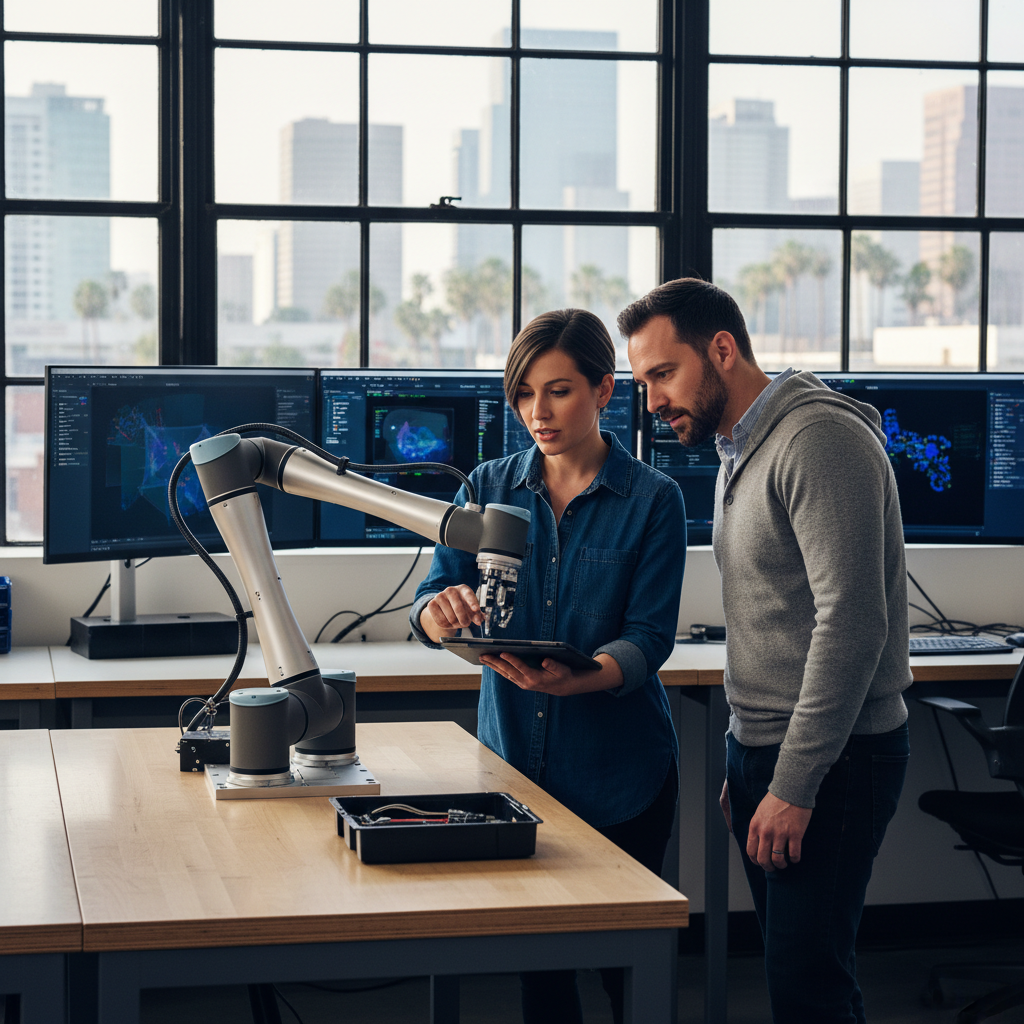
Today, artificial intelligence is stepping off the screen. We are entering the era of Physical AI—often referred to as embodied intelligence. This paradigm combines modern foundation models, vision-language-action (VLA) architectures, spatial computing, and advanced sensor fusion to enable software to perceive, reason about, and physically manipulate the three-dimensional world.
For early-stage founders and deep tech researchers, building a Physical AI company is fundamentally different from launching a software-as-a-service (SaaS) startup. It requires reconciling the rapid iteration speed of machine learning with the unforgiving laws of physics, supply chain constraints, and edge deployment economics. Below is a strategic and tactical guide to navigating this frontier.
Understanding the Physical AI Architecture
To build effectively in this domain, founders must look past generic robotics frameworks and understand how modern AI layers interface with mechanical systems. A modern Physical AI system does not rely on rigid, hard-coded heuristics. Instead, it relies on a multi-tiered architecture that translates ambient physical inputs into predictable physical actions.
1. Multi-Modal Sensory Ingestion
Traditional automated systems rely on narrow, calibrated inputs such as optical encoders or single-beam LiDAR. Physical AI relies on multi-modal sensory fusion: combining cameras, event sensors, depth mapping, tactile feedback arrays, and inertial measurement units (IMUs). The objective is not just data collection, but state estimation under noisy, dynamically changing real-world conditions.
2. World Models and Spatial Representation
Instead of treating each frame or sensor ping as an isolated instance, Physical AI maintains an internal model of environment dynamics. These spatial representations—increasingly powered by neural radiance fields (NeRFs), 3D Gaussian splatting, and learned world models—allow an agent to predict how physical objects will react to force, friction, gravity, and human intervention.
3. Policy Execution and Action Generation
This layer translates semantic understanding into motor control. Vision-Language-Action (VLA) models allow robots to process natural language instructions alongside visual streams, generating trajectory coordinates and joint torque commands directly. The challenge is moving from probabilistic predictions to deterministic, millisecond-accurate actuation.
4. Edge Compute and Thermal Budgets
Unlike cloud-based generative AI, physical agents cannot tolerate round-trip latency to remote data centers when operating heavy machinery or navigating crowded environments. Compute must sit on the edge. Platforms powered by specialized edge processors—such as NVIDIA Jetson modules—must balance compute density with extreme thermal, power, and payload constraints.
The Core Strategic Pillars of Physical AI Ventures
Transitioning a laboratory prototype into a repeatable commercial product demands a rigorous approach to system design, validation, and field deployment. Founders who succeed consistently align their operations around three core pillars.
The Sim-to-Real-to-Sim Flywheel
Real-world testing is slow, expensive, and dangerous. Conversely, pure simulation often suffers from the "reality gap," where models overfitted to synthetic environments fail when confronted with unpredictable lighting, dust, or sensor degradation.
The leading Physical AI teams build a continuous closed loop:
- Simulation at Scale: Use physics engines to train baseline policies across millions of parallel synthetic variations, randomizing textures, mass, friction, and lighting.
- Targeted Real-World Deployment: Deploy hardened policies onto hardware in controlled environments, capturing the long tail of edge cases where the model exhibits high uncertainty.
- Ingestion and Domain Adaptation: Feed real-world failures back into the simulator as newly parameterized environments, refining the baseline model.
Hardware-Software Co-Design
A common mistake among software-centric founders is treating hardware as a commoditized shell. In Physical AI, hardware choices directly dictate software tractability. A slightly wider camera field of view or a relocated tactile sensor can eliminate thousands of hours of computer vision training. Co-design means machine learning engineers and mechanical designers solve problems together, selecting sensors that actively simplify policy complexity rather than compensating for poor hardware with over-parameterized models.
Graceful Degradation and Deterministic Safety
Physical systems operate alongside humans and heavy physical assets. Probabilistic hallucinations in text models produce factual inaccuracies; probabilistic hallucinations in Physical AI produce collisions, dropped payloads, and operational shutdowns. Every Physical AI architecture requires a deterministic safety cage: traditional rule-based controllers, hard stops, and mechanical interlocks that override neural policies whenever confidence drops below a defined threshold.
Four Common Pitfalls Founders Must Avoid
Many brilliant teams fail not because their underlying algorithms are flawed, but because they misjudge the operational realities of hardware-integrated software.
- The Simulation Mirage: Assuming that high performance in a simulated physics engine guarantees success in the real world. Real friction, wire fatigue, sensor noise, and mechanical backlash consistently derail naive simulation policies.
- Premature Generalization: Attempting to build a general-purpose robotic assistant before mastering a single, constrained physical interaction. Specificity creates defensibility; solving one industrial corner case completely is far more valuable than solving ten partially.
- Underestimating Teleoperation Costs: Relying on human-in-the-loop intervention without tracking the unit economics of human labor. If human operators must intervene every five minutes, the labor arbitrage disappears and the gross margins collapse.
- Ignoring Field Serviceability: Designing an integrated system that cannot be repaired on-site by standard industrial technicians. If a machine requires a robotics PhD to swap a burned-out sensor, it will not scale.
Practical Steps You Can Take This Week
If you are leading an early-stage team in the Physical AI space, shift your focus from abstract model optimization to operational reality. Here is an actionable roadmap founders can execute immediately.
1. Measure Your Time-to-Intervention (TTI)
Identify your system's Mean Time Between Human Interventions (MTBI). Track this metric obsessively across both simulated and physical runs. High-level autonomy claims mean nothing if intervention frequency makes commercial deployment cost-prohibitive.
2. Audit the Edge Thermal and Power Budget
Run your models under continuous peak load for two hours on target edge hardware within its intended chassis. Measure thermal throttling, voltage stability, and battery degradation. If your model throttles when ambient temperatures hit 35°C, your software architecture is already failing in the field.
3. Establish a Concrete Failure Classification Matrix
Classify every physical failure into one of four buckets:
- Perception failure: The sensor did not register the target accurately.
- Reasoning failure: The model misunderstood the physical context or intent.
- Actuation failure: The command was correct, but mechanical limits prevented execution.
- Environmental anomaly: External factors exceeded operational design domains.
Knowing where your errors cluster allows you to allocate engineering resources precisely where they move the needle.
4. Build a Micro-Data Flywheel for One Specific Motion
Select a single high-value physical interaction—such as picking a reflective object, inserting a flexible cable, or navigating a dynamic corridor. Constrain the problem, capture one thousand real variations, train an end-to-end model, and measure the accuracy improvement relative to your baseline. Prove the loop works on one motion before scaling to the entire workflow.
Summary Framework for Physical AI Teams
To keep your core team aligned across software, hardware, and commercial milestones, evaluate your company against this four-part checklist:
- Environment Definition: Have you precisely documented the Operational Design Domain (ODD), including lighting variations, surface frictions, and operating temperatures?
- Data Architecture: Does your pipeline automatically ingest real-world failures, convert them into simulated test cases, and retrain policies without manual intervention?
- Safety Boundaries: Does the machine feature independent, deterministic safety systems that run outside the primary neural model?
- Unit Economics: Does your total cost of hardware, compute, and teleoperation yield a payback period under twelve months for your target industrial or commercial customer?
Physical AI is not simply software applied to hardware; it is a new discipline requiring deep empathy for physical constraints and unyielding focus on reliability. Those who master the interplay between digital models and physical matter will build the foundational industrial platforms of the next half-century.
How Synapses Ventures Can Help
At Synapses Ventures, we partner with founders, academic researchers, and visionary technologists who are translating complex technological breakthroughs into sustainable, world-changing companies. We recognize that building at the frontier of Physical AI requires more than standard venture capital—it demands deep technological fluency, patient capital structures, and hands-on venture building support.
Our team works alongside early-stage entrepreneurs from inception: refining core technical architectures, navigating hardware supply chains, structuring rigorous real-world validation pilots, and aligning hardware-software roadmaps. Through our global network of research institutions, corporate partners, and co-investors, Synapses Ventures provides the commercial and strategic runway founders need to de-risk embodied intelligence systems and achieve industrial scale.
If you are developing breakthrough technologies in Physical AI, robotics, or edge computing, we invite you to connect with us. Together, we can build the enduring physical platforms that power the future.
Share this article
Physical AI: Bridging Foundation Models and the Real World

Physical AI represents the next major technological frontier where digital intelligence moves beyond screens and operates inside the material world.

Inside the piece:
• What actually moves the needle for early-stage founders
• How we apply it across the Synapses venture portfolio
• The practical next step you can take this week

Read the full article → https://synapsesventures.com/s/physical-ai-guide-founders

#SynapsesVentures #DeepTech #FrontierTech #RnD