Deep Tech
Physical AI: The Founder's Guide to Embodied Systems

For the past decade, the center of gravity in artificial intelligence has been almost exclusively digital. Models ingested text, rendered synthetic imagery, parsed financial spreadsheets, and generated code within the sanitary confines of cloud data centers. In these digital environments, latency penalties mean a delayed browser render, edge cases can be mitigated with human-in-the-loop fallback interfaces, and compute environments remain predictable, temperature-controlled, and uniform.
Physical AI changes every variable in that equation.
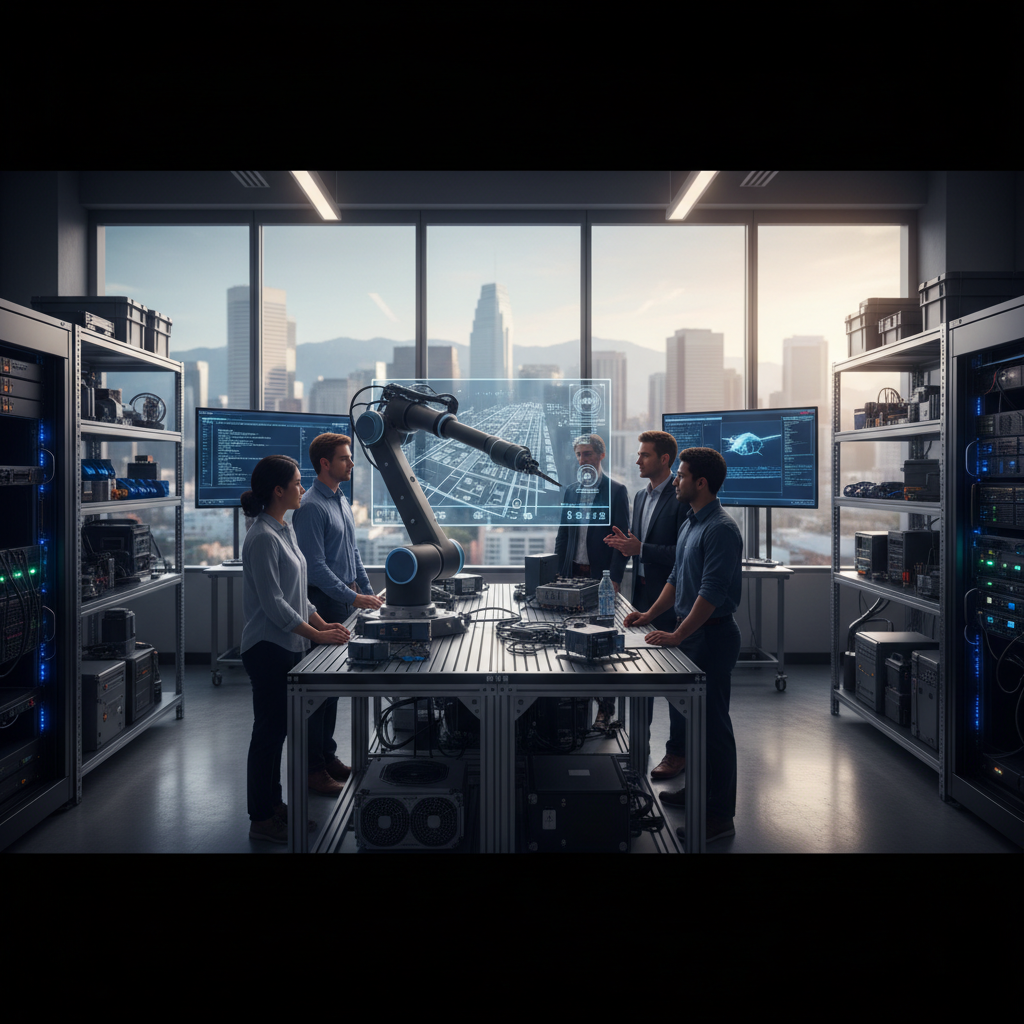
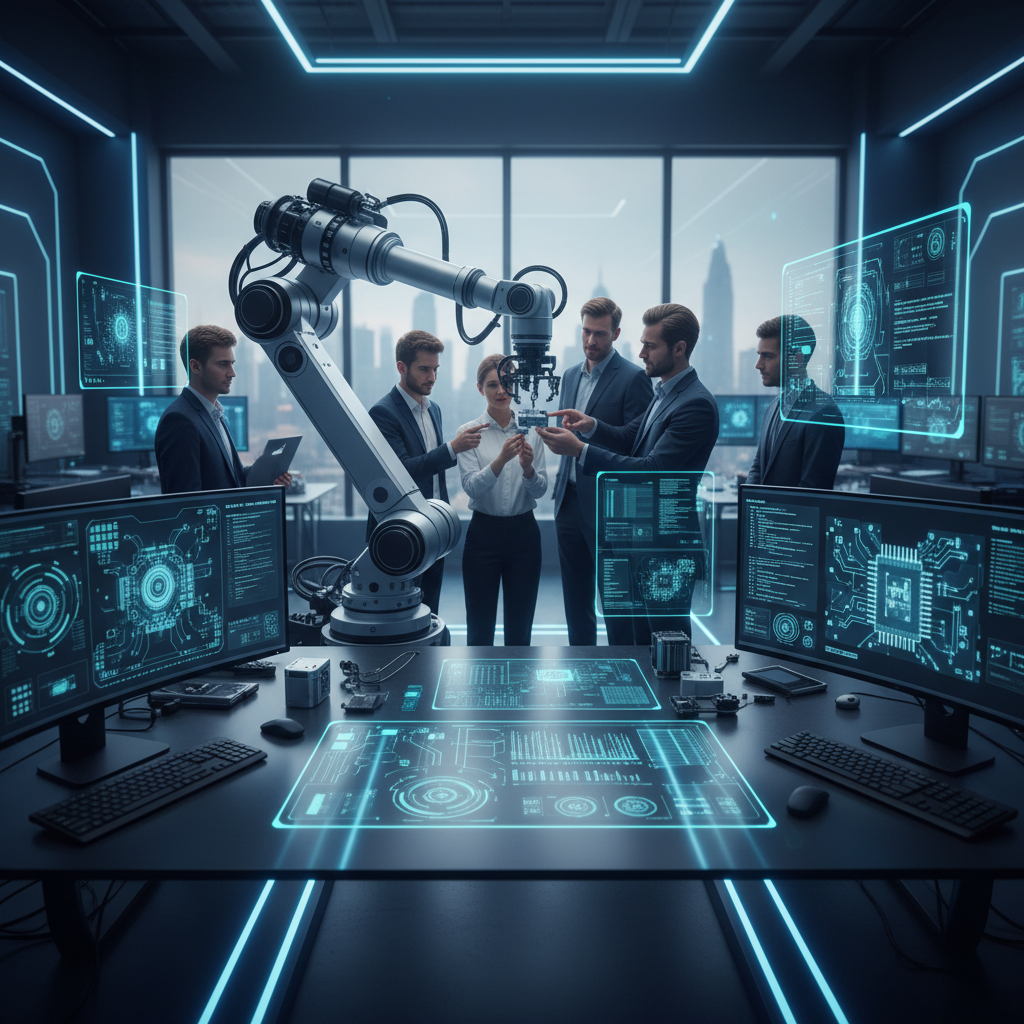
When intelligence leaves the screen and enters physical space—whether inside autonomous mobile robots, robotic arms, surgical systems, smart agricultural implements, or distributed grid sensors—it must contend with the chaotic, non-deterministic physics of the real world. Gravity, friction, optical occlusion, thermal throttling, mechanical backlash, and physical degradation become continuous architectural constraints.
For early-stage founders, building a company at the intersection of foundation models and physical machines is one of the most promising yet unforgiving frontiers in modern technology. Navigating this intersection requires moving beyond the standard playbook of pure software venture creation. Success demands a rigorous grasp of the feedback loops between sensory perception, real-time actuation, deterministic safety, and capital-efficient commercialization.
Understanding the Anatomy of Physical AI
To build effectively in this domain, founders must distinguish between traditional embedded automation and true physical AI. Legacy industrial robotics relies heavily on deterministic trajectories: a mechanical manipulator moves along precisely coded coordinates, assuming its operating environment will remain completely static. When an unexpected obstacle enters the workspace, the machine stops or fails.
Physical AI, by contrast, operates on continuous closed-loop perception, cognition, and actuation. It leverages multimodal sensory inputs—such as spatial compute, tactile feedback, computer vision, and inertial telemetry—to construct a dynamic understanding of its environment. It uses learned policies to plan and execute tasks under conditions of extreme ambiguity.
The core architecture of modern physical AI systems rests on three interdependent layers:
- High-Bandwidth Sensing & Edge Processing: The ingestion of multimodal real-world data via cameras, LiDAR, radar, and force-torque sensors, processed locally with low power consumption and microsecond-level latency budgets.
- World Modeling & Cognitive Reasoning: The high-level model layer, often powered by vision-language-action (VLA) architectures, that understands semantic intent, evaluates environmental state changes, and generates contextual motion plans.
- Deterministic Control & Actuation: The low-level, high-frequency control loops that translate semantic instructions into torque, velocity, and trajectory commands while guaranteeing physical safety parameters.
Companies like Tesla and NVIDIA have demonstrated the immense capital and computational investment required to advance spatial models and end-to-end learning for vehicles and humanoids. However, the largest market opportunity for emerging startups lies in applied, domain-specific physical systems that solve constrained, economically valuable problems in logistics, manufacturing, infrastructure, and healthcare.
The Sim2Real Bridge: From Synthetic Environments to Reality
One of the most consequential strategic decisions a deep tech founder makes is how to architect the bridge between synthetic training environments and physical deployment. This is commonly known as the Simulation-to-Reality (Sim2Real) challenge.
Training policies directly on physical hardware is slow, cost-prohibitive, and dangerous. A policy learning to grasp irregular composite parts through trial-and-error can destroy physical prototypes or damage high-precision actuators within hours. As a result, founders rely heavily on physics simulators to generate millions of synthetic training trajectories in parallel.
Yet, pure simulation inevitably suffers from the reality gap. Physics engines simplify fluid dynamics, surface friction, micro-vibrations, and sensor noise. When a policy trained purely in a digital sandbox encounters an uncalibrated optical lens or an oily factory floor, performance degrades rapidly.
The Sim2Real Execution Matrix
To cross this divide sustainably, successful technical teams employ a disciplined progression:
- Aggressive Domain Randomization: During simulation training, deliberately vary every physical and visual variable—lighting angles, object textures, camera noise, friction coefficients, and mechanical mass distributions. When the model sees millions of variations in simulation, the actual real world appears merely as another variation within its learned distribution.
- Hardware-in-the-Loop (HIL) Verification: Before deploying policies into field pilots, run your control software against real edge chips coupled with real sensor payloads observing simulated physics rigs. This verifies that computational thermal limits, memory bandwidth, and bus latencies do not break control frequencies.
- Active Physical Teleoperation for Shadow Data: Gather real-world teleoperation data specifically targeted at edge cases where your model shows low predictive confidence. Physical edge data is orders of magnitude more valuable when it specifically targets policy failure modes rather than baseline routines.
- Conservative Low-Level Guardrails: Decouple semantic exploration from low-level safety. Your high-level VLA model can suggest actions, but a hardcoded, deterministic controller should always enforce operational envelopes, velocity maximums, and collision-avoidance buffers.
Four Critical Mistakes Physical AI Founders Make
Deep tech founders frequently bring pure software assumptions to physical systems. This structural mismatch burns capital quickly. Avoid these common traps:
1. Building Custom Hardware Too Early
Many engineering founders start their company by designing custom mechanical chassis, bespoke printed circuit boards (PCBs), or proprietary sensor clusters. In the earliest phase of venture building, custom hardware is an expensive distraction. Whenever possible, purchase commercial off-the-shelf (COTS) robotic platforms, standard industrial compute boards, and commercially available depth sensors to validate your policy and workflow value first. Only design proprietary hardware when a verified customer workflow cannot be unlocked using off-the-shelf components.
2. Treating Edge Latency as a Software Optimization Task
In standard enterprise SaaS, optimizing an API response from 250 milliseconds to 80 milliseconds improves the user experience. In physical AI, waiting 200 milliseconds for a cloud inference response to determine if an articulated arm should stop can cause irreversible mechanical damage or human injury. Treat inference speed, sensor bus serialization, and control loops as fundamental architectural constraints from day zero, not as performance polish to be addressed before launch.
3. Neglecting Field Operations and Maintenance Friction
Founders often design their demonstrations under pristine laboratory conditions: stable lighting, clean air, stable 10-gigabit local Wi-Fi, and spotless concrete. Real deployment environments are filled with dust, vibration, unpredictable cellular dead zones, ambient electromagnetic interference, and operators with zero technical training. If your system cannot handle a smudged lens, an unexpected power cycle, or a missing network connection gracefully, it is not ready for the field.
4. Premature Generalization
While universal foundation models for robotics represent an exciting long-term research direction, companies that raise venture capital must solve real commercial pain points today. Trying to build a physical agent that can clean an office, harvest strawberries, and assemble automotive parts simultaneously yields mediocre performance across all three. Specialize relentlessly. Master a single industrial or commercial task with superior reliability, build the sensory data flywheel, and expand outward only after establishing operational defensibility.
Actionable Frameworks: What to Execute This Week
If you are actively leading or building an embodied AI startup, theoretical frameworks must translate into immediate, tactical engineering and product milestones. Here is a practical roadmap you can execute across your team this week:
Action 1: Audit Your Edge Latency and Bandwidth Budgets
Gather your hardware, firmware, and machine learning leads for a dedicated architectural audit. Map the exact data path from photons hitting the sensor to physical motor torque:
- Sensor capture time + ISP processing: Target < 15ms
- Data bus transfer (e.g., PCIe, USB3, MIPI) to inference engine: Target < 5ms
- Model inference on edge neural processing units: Target < 30ms
- Trajectory planning and inverse kinematics validation: Target < 10ms
- Actuator CAN/EtherCAT bus transmission: Target < 2ms
- Total control loop objective: Maintain a minimum 20Hz (preferably 50Hz+) end-to-end closed-loop frequency for dynamic tasks.
Action 2: Establish a Failure-Case Ingestion Pipeline
Review how your current prototype handles edge cases. If a physical test run fails today, how long does it take for that telemetry, camera footage, and control state to enter your training dataset? Build an automated script this week that flags anomalous trajectory variances, captures the preceding five seconds of multimodal sensor telemetry, and uploads the compressed packet directly to your engineering team's triage queue.
Action 3: Implement Operational Failsafe Decoupling
Ensure your low-level motion controller operates independently of your neural network's stability. If the operating system running your deep neural model freezes or experiences memory exhaustion, your microcontroller or programmable logic controller (PLC) must detect the heartbeat loss within 10 milliseconds and bring all kinetic motion to a safe, controlled stop using deterministic braking logic.
Action 4: Define Your Unit Economics of Automation
Calculate the real operational cost equation your customer uses to evaluate your system:
$$\text{Net Value} = (\text{Baseline Labor/Inefficiency Cost}) - (\text{Hardware CapEx Amortization} + \text{System Maintenance} + \text{Intervention Handling Cost})$$
Notice that Intervention Handling Cost is often the hidden killer of robotics startups. If your system runs autonomously 95% of the time, that sounds impressive in a research paper. In a commercial facility, an unexpected failure every twenty minutes requires a dedicated human minder, completely destroying your customer's return on investment. Design for 99.9% task completion within narrow operational domains before broadening your scope.
The Strategic Road Ahead
The trajectory of artificial intelligence is moving steadily toward embodied presence. The foundational breakthroughs achieved in language and vision models are now offering the cognitive scaffolding required to make sense of the physical world. However, the companies that define this era will not be those that simply deploy standard multimodal models onto robotic frames.
The winners will be founders who respect the laws of physics as deeply as they respect algorithmic architecture. They will obsess over reliability, build deep operational feedback loops, optimize for latency at the edge, and solve critical industrial and societal bottlenecks.
Physical AI is not simply about teaching computers to see; it is about empowering machines to act responsibly, effectively, and safely in the world we inhabit every day.
How Synapses Ventures Can Help
Transforming breakthrough physical intelligence from a lab concept into an enterprise-ready system requires a unique blend of deep technical validation, hardware engineering discipline, and commercial execution.
Synapses Ventures works alongside ambitious founders, researchers, and technical innovators at the earliest stages of their journey. We operate as an active venture builder and investment partner, helping teams navigate the complexities of deep tech commercialization. Whether you are solving the Sim2Real challenge, selecting edge compute architectures, designing scalable manufacturing supply chains, or structuring enterprise pilot contracts, our platform provides hands-on strategic guidance, technical expertise, and access to a global ecosystem of industrial partners, domain mentors, and capital networks.
If you are building technologies that bridge digital intelligence and physical execution, Synapses Ventures can help you translate your breakthroughs into enduring, scalable ventures.
Share this article
Physical AI: The Founder's Guide to Embodied Systems

As artificial intelligence transitions from digital screens to the physical world, founders face unprecedented engineering and commercial challenges.

Inside the piece:
• What actually moves the needle for early-stage founders
• How we apply it across the Synapses venture portfolio
• The practical next step you can take this week

Read the full article → https://synapsesventures.com/s/physical-ai-founders-guide-embodied-systems

#SynapsesVentures #DeepTech #FrontierTech #RnD