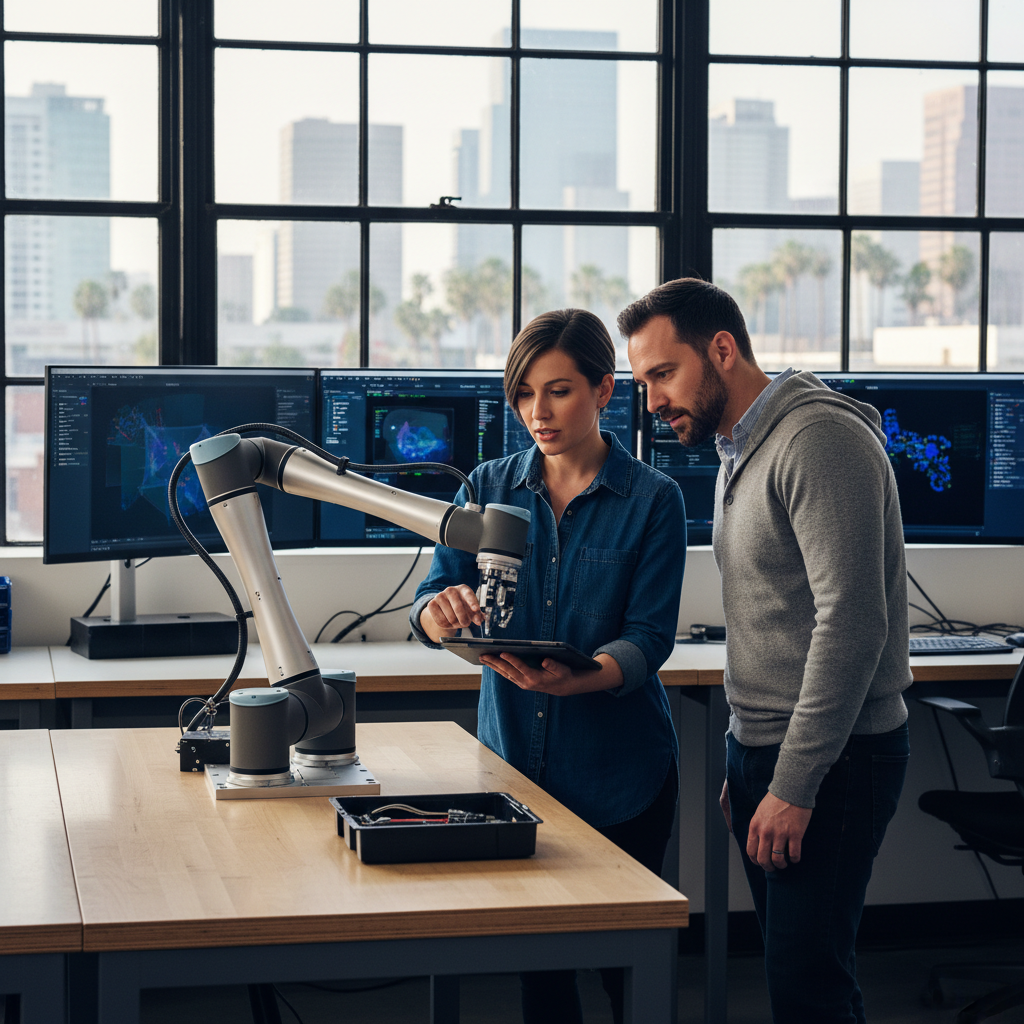
Deep Tech
Physical AI: Bridging Foundation Models and the Physical World

For the past decade, artificial intelligence has largely operated inside screens. We have witnessed remarkable transformations in natural language processing, creative synthesis, and predictive analytics. Yet, the physical world—where humanity lives, manufactures, transports, and builds—remains largely untouched by autonomous intelligence.
This dynamic is changing rapidly. The convergence of multimodal foundation models, spatial computing, physics-informed neural networks, and high-fidelity simulation environments has unlocked what many now term Physical AI. Physical AI refers to artificial intelligence systems that possess a deep understanding of physical laws, allowing them to sense, reason, predict, and execute actions within the real world.
For deep tech founders, university researchers, and engineering leaders, this inflection point presents an unprecedented opportunity. Moving from digital bits to physical atoms introduces complex systems challenges, distinct unit economics, and unique product development cycles. This guide outlines the essential frameworks, real-world operational trade-offs, and immediate actions founders can apply this week to build resilient, venture-scale Physical AI enterprises.
The Shift from Digital Generative AI to Physical Agency
Purely digital generative models process text, code, or images in abstract latent spaces. While they can generate photorealistic imagery or analyze vast datasets, they lack intrinsic awareness of mass, friction, inertia, gravity, and spatial permanence. If a digital model hallucinates, the cost is an erroneous sentence or an anomalous pixel. When a physical system miscalculates, hardware collides, operations halt, and safety is compromised.
Physical AI introduces closed-loop interaction between the digital model and the physical environment. It encompasses robotics, autonomous logistics, spatial intelligence, industrial automation, and smart physical infrastructure. Several foundational shifts are accelerating this transition:
- Multimodal Perception at Scale: Vision-language-action (VLA) models allow systems to interpret sensory streams (RGB cameras, LiDAR, tactile sensors, and depth arrays) directly into physical actuation commands.
- High-Fidelity Physics Simulation: Platforms like NVIDIA Isaac and Omniverse allow teams to simulate decades of physical interaction within photorealistic, physics-accurate virtual environments prior to deploying real-world metal.
- Edge Silicon Acceleration: Specialized system-on-chips (SoCs) and tensor accelerators now run quantized inference models on devices with strict power, thermal, and weight constraints.
- Embodied Data Engines: The systematic gathering of real-world operational data via teleoperation, automated fleets, and synthetic data pipelines is closing the long-standing "sim-to-real" gap.
Founders who succeed in this domain do not simply apply an off-the-shelf digital language model to a robotic chassis. Instead, they rethink architecture, continuous learning loops, and validation frameworks from first principles.
The Physical AI Stack: A Core Architecture for Founders
To build a scalable Physical AI venture, founders must structure their technological roadmap around four tightly coupled layers.
+-------------------------------------------------------------+ | 4. Deterministic Safety & Actuation (Control, Guardrails) | +-------------------------------------------------------------+ | 3. Foundation World Models & Policy Engine (VLA, Reasoning) | +-------------------------------------------------------------+ | 2. Unified Simulation & Spatial Data Engine (Sim-to-Real) | +-------------------------------------------------------------+ | 1. Multimodal Sensory & Edge Compute Layer (Hardware BOM) | +-------------------------------------------------------------+
1. Multimodal Sensory and Edge Compute Layer
Your system must capture the physical world with deterministic latency. Physical AI architectures rely on heterogeneous sensor suites tailored to specific operational design domains (ODDs). Balancing sensor redundancy against hardware Bill of Materials (BOM) cost is critical during early development.
2. Unified Simulation and Spatial Data Engine
Real-world data collection is expensive, hazardous, and difficult to scale. World-class Physical AI startups invest heavily in synthetic data generation and domain randomization. By altering physical parameters—such as surface friction, lighting conditions, object mass, and texture variance—within a simulated world, models learn generalized representations that survive contact with reality.
3. Foundation World Models and Policy Engines
At the core of Physical AI is a model that understands cause and effect. World models predict how the environment will evolve in response to an action before that action is taken. This predictive horizon enables proactive planning rather than purely reactive feedback loops.
4. Deterministic Safety and Actuation
Neural networks are inherently probabilistic; physical environments demand deterministic safety. The most successful physical deployments use hybrid architectures: modern probabilistic foundation models handle perception and high-level strategy, while classical, deterministic control algorithms (e.g., Model Predictive Control) govern execution, dynamic stability, and emergency boundaries.
Tactical Guidance: What Founders Can Execute This Week
If you are leading an early-stage Physical AI startup or transitioning research from an academic lab to commercial deployment, focus on these five immediate operational priorities:
1. Define a Narrow Operational Design Domain (ODD)
The most common failure mode is attempting to solve generalized manipulation or navigation out of the gate. Generalization is a consequence of scale, not a starting point. Constrain your deployment environment aggressively:
- Specify dynamic variables: Define acceptable lighting ranges, floor gradients, ambient temperatures, and dust levels.
- Specify physical variance: Determine the exact weight distributions, surface geometries, and material properties of the objects your system must handle.
- Create an ODD boundary document: Share this with engineering and prospective enterprise pilots to align expectations.
2. Audit the Edge-to-Cloud Latency Budget
Map the complete inference and control loop. In physical systems, high inference latency translates directly to reduced operational speed or safety risks.
- Measure sensory input capture time, serialization, preprocessing, model inference, and output translation to motor controllers.
- Target a tight control frequency (e.g., 20 Hz to 100 Hz for high-level guidance, >500 Hz for low-level motor actuation).
- Quantize your models to 8-bit or 4-bit precision to run locally on target edge hardware (such as mobile compute modules) without relying on cloud round-trips for critical paths.
3. Construct a Minimum Viable Sim-to-Real Pipeline
Do not wait for complete physical hardware assemblies before testing control policies. Establish a unified continuous integration (CI) pipeline that tests every code commit in a physics simulator.
- Introduce domain randomization: Randomize mass, inertia matrices, friction coefficients, and camera noise by ±20% during automated regression tests.
- Track transfer performance: Measure the performance drop when a policy trained in simulation runs on physical verification benches.
4. Standardize Teleoperation and Human-in-the-Loop Logging
Data collection must be treated as a product feature. If your team manually operates or tests hardware, capture multimodal data systematically.
- Log raw sensor streams alongside synchronized joint telemetry, actuator currents, and external video feeds.
- Implement a "one-click failure flag" during hardware runs so field technicians can tag edge cases instantly for subsequent model fine-tuning.
5. Review Unit Economics and the Hardware BOM
Software gross margins rarely apply directly to Physical AI ventures during initial deployments. Calculate your true unit economics:
- Account for sensor lifespans, recalibration intervals, thermal throttling, and field maintenance costs.
- Build a path from prototype components to scalable manufacturing processes that maintain viable enterprise gross margins over time.
Common Pitfalls in Physical AI Development
Building physical systems requires navigating distinct traps that digital software founders rarely encounter.
Relying Exclusively on Simulation
While simulation is indispensable, physics engines are approximations. Unmodeled micro-vibrations, thermal expansion of mechanical arms, sensor degradation over time, and optical glare can quickly break models trained solely in synthetic environments. Sim-to-real parity requires constant validation against ground-truth physical hardware.
Over-Engineering General-Purpose Hardware
Founders often default to building proprietary hardware from scratch, consuming significant capital on custom sheet metal and motor controllers. Wherever possible, validate your initial AI policies using standardized, commercially available robotic arms, mobile platforms, and off-the-shelf edge computers. Prove the value of your spatial intelligence before investing millions in bespoke mechanical tooling.
Ignoring the Teleoperation Fallback
Autonomy is not binary; it is a spectrum. Enterprise customers care about overall task completion rates and return on investment, not whether the system achieved 100% autonomous intervention-free operation on day one. Establish robust remote teleoperation capabilities with graceful degradation. When the model encounters a low-confidence state, a remote operator should seamlessly resolve the edge case, simultaneous with logging the event to train the next iteration.
The Strategic Path Forward
Physical AI is reshaping sectors that represent the vast majority of global GDP: manufacturing, agriculture, warehousing, construction, and healthcare logistics. The technological leaders of the next generation will be those who bridge the gap between abstract algorithmic capabilities and the physical realities of friction, inertia, and hardware reliability.
Success requires a founder mindset that combines deep technical rigor in machine learning with operational discipline in hardware, testing, and continuous deployment. By anchoring your product in a defensible, narrow operational design domain, establishing reliable simulation loops, and designing for edge constraints, you can systematically translate research breakthroughs into scalable, real-world value.
How Synapses Ventures Can Help
Transforming breakthrough physical science, spatial models, and robotics research into scalable, commercially viable enterprises requires a distinct venture building playbook.
Synapses Ventures partners with visionary founders, university researchers, and deep technology innovators at the intersection of bits and atoms. Through our hands-on venture builder model, we support teams in navigating the complexities unique to Physical AI, including:
- Strategic Architecture & Roadmapping: Aligning foundation model capabilities with deterministic control architectures, hardware selection, and edge compute trade-offs.
- Commercialization & Piloting: Defining precise operational design domains and structuring enterprise pilot agreements with industrial partners.
- Operational & Hardware Scaling: Transitioning prototypes from research benches to reproducible production runs and field-tested deployments.
- Capital & Global Ecosystem Access: Providing access to patient, deep-tech capital, manufacturing networks, and strategic partners across Silicon Valley and global innovation hubs.
If you are developing breakthrough technologies in Physical AI, spatial computing, or intelligent automation, reach out to explore how we can build the future of physical intelligence together.
Share this article
Physical AI: Bridging Foundation Models and the Physical World

As artificial intelligence expands beyond digital screens, Physical AI represents the next major frontier of commercial innovation.

Inside the piece:
• What actually moves the needle for early-stage founders
• How we apply it across the Synapses venture portfolio
• The practical next step you can take this week

Read the full article → https://synapsesventures.com/s/physical-ai-guide-for-founders

#SynapsesVentures #DeepTech #FrontierTech #RnD