Deep Tech
Building Physical AI: A Strategic Playbook for Founders

For the past decade, artificial intelligence has largely operated within the confines of digital bits. Large language models, recommendation systems, and creative tools have transformed how software interacts with text, images, and audio. Yet the physical world—where humans live, build, manufacture, and transport—has remained governed by legacy deterministic automation.
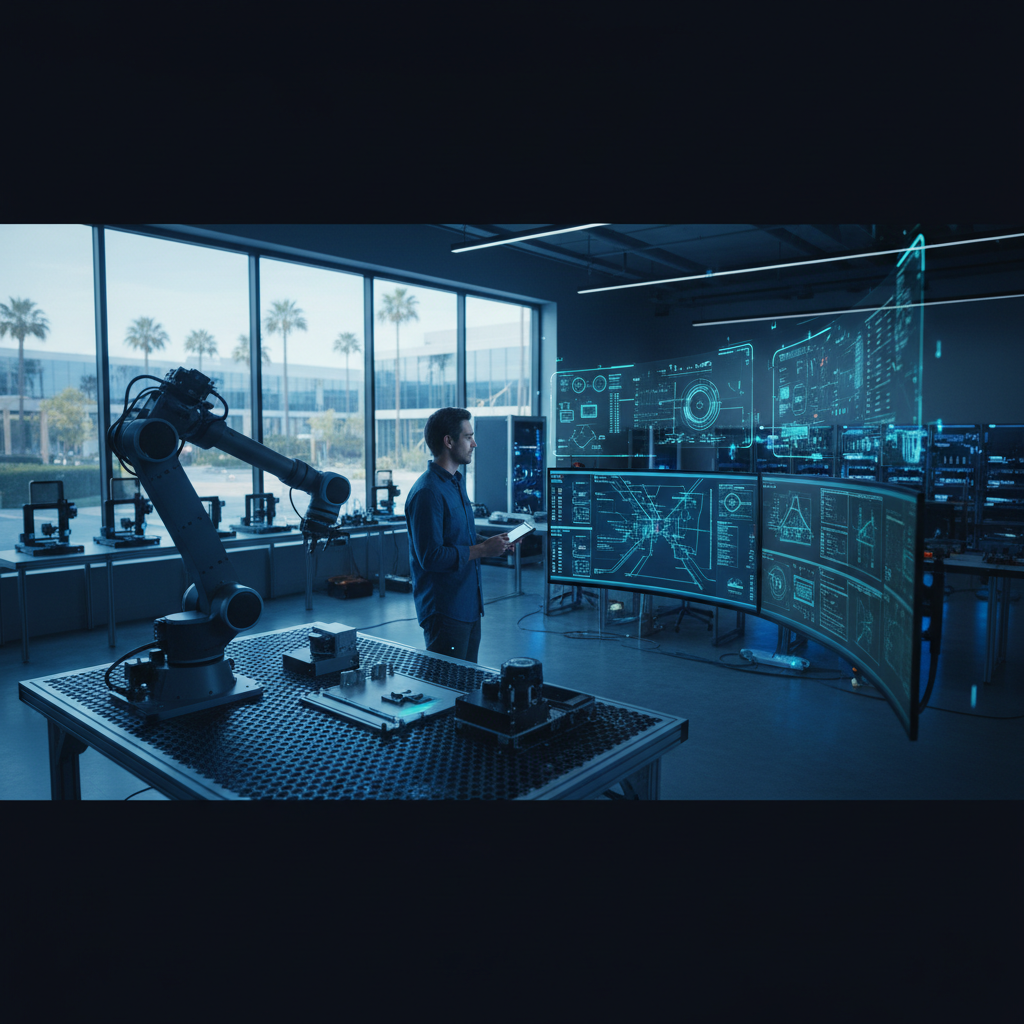
That paradigm is rapidly shifting. We are entering the era of Physical AI, often referred to as embodied intelligence. Physical AI describes intelligent systems that do not merely generate tokens on a screen; they perceive their environment, reason about spatial constraints, and execute purposeful mechanical actions in dynamic, unstructured physical environments.
For founders building in this space, the opportunities are immense, but the hurdles are distinctly different from pure software companies. In software, edge cases cause an error log; in Physical AI, edge cases can cause a mechanical failure or safety risk. Moving from bits to atoms requires a rethink of development cycles, validation loops, and commercialization models. This guide outlines the fundamentals of Physical AI and provides an actionable operational playbook you can implement today.
Understanding the Physical AI Paradigm Shift
To build effectively, founders must first understand why Physical AI is emerging now and what distinguishes it from traditional industrial robotics.
Traditional robotics relies on deterministic programming. An industrial arm on an automotive assembly line moves to exact millimeter coordinates in a tightly controlled environment. If an unexpected object enters its path, the system stops or fails. The machine lacks perception; it executes instructions without understanding context.
Physical AI, by contrast, integrates perception, foundation models, and control loops:
- Multimodal Perception: Combining stereo cameras, LiDAR, and tactile sensors to build a spatial representation of the physical space in real time.
- Vision-Language-Action (VLA) Models: Emerging architectures that translate visual observations and natural language instructions directly into low-level kinematic controls.
- Continuous Adaptation: Policies trained using reinforcement learning that adapt to friction changes, uneven terrain, lighting shifts, and object variations without explicit manual reprogramming.
This shift is catalyzed by key technical inflection points: the democratization of spatial simulation tools, significant improvements in high-performance edge compute platforms such as those pioneered by NVIDIA, and the convergence of multimodal foundation models with high-frequency control software.
The Core Challenge: Navigating the Sim-to-Real Gap
Every Physical AI company confronts the "reality gap"—the discrepancy between how an algorithmic policy performs in a digital simulation and how it behaves when deployed on physical hardware.
Simulation is essential. Gathering millions of real-world trials on physical robots is cost-prohibitive, slow, and prone to hardware damage. In simulation, an agent can experience thousands of operational hours within minutes. However, simulations struggle to perfectly capture real-world friction, sensor noise, latency jitter, wear-and-tear, and unpredictable contact mechanics.
The Three-Tier Sim-to-Real Framework
Founders who succeed treat sim-to-real not as a one-time handoff, but as a continuous bidirectional feedback cycle:
- High-Variance Domain Randomization: During simulation, deliberately randomize variables such as lighting, surface friction, camera angles, mass distribution, and actuator response times. If an agent learns to balance on twenty simulated surfaces, it is far more likely to generalize to an unmodeled physical surface.
- Hardware-in-the-Loop (HIL) Validation: Integrate the actual edge compute board and physical microcontrollers directly into the simulation loop before attaching motors and chassis. This uncovers latency bottlenecks, memory bandwidth limits, and thermal throttling before mechanical testing begins.
- Closed-Loop Telemetry Ingestion: Treat every physical deployment as an edge data collection node. When a real robot encounters an edge case, that physical trajectory must be automatically converted into a targeted simulation test case to update the model.
Four Common Mistakes in Physical AI Ventures
Building at the intersection of bits and atoms introduces distinct operational hazards. Avoid these four common missteps:
- Premature Custom Hardware Engineering: Founders frequently spend their earliest capital designing custom chassis, gearboxes, and printed circuit boards before validating their core intelligence model. Using off-the-shelf actuators, standard sensors, and reference compute kits preserves precious capital and speeds up software iteration.
- The Actuation Latency Blind Spot: In pure software, a 150-millisecond inference delay is often acceptable. In physical systems moving at speed, an extra 50 milliseconds between camera frame capture and motor actuation can result in unstable oscillations or physical collisions. Latency is a fundamental safety parameter.
- Ignoring Field Serviceability and Thermal Envelopes: Labs are air-conditioned, clean, and well-lit. Production environments—such as warehouses, farm fields, and construction sites—are dusty, hot, and vibration-heavy. Software models that run smoothly in a temperature-controlled office can degrade quickly under thermal throttling in the field.
- Underestimating Edge Data Pipeline Costs: Streaming high-resolution point clouds and multi-camera video streams from hundreds of machines to the cloud for retraining creates massive cellular bandwidth and storage costs. Successful founders build intelligent filtering at the edge, logging only novel or anomalous trajectories.
Actionable Steps Founders Can Implement This Week
If you are currently leading a Physical AI venture, here are four concrete, practical initiatives to evaluate this week:
1. Audit Your Sensor-to-Actuator Latency Budget
Map the complete data pipeline of your system from end to end. Break down the time required for:
- Sensor exposure and data transfer
- Perception model inference
- Motion planning and policy evaluation
- Controller execution and CAN-bus signal delivery
Identify the single largest latency bottleneck. Aim to reduce total round-trip latency to a level where mechanical stability is mathematically guaranteed across your operational parameters.
2. Implement Automated Domain Randomization in Simulation
Review your current simulation environment. Are you testing against idealized digital twins? Introduce systematic noise into your physics engine:
- Vary surface friction coefficients by plus or minus twenty percent.
- Introduce random sensor dropouts and artificial latency spikes.
- Add simulated camera lens glare, motion blur, and sensor grain.
If your policy fails under synthetic variations, it will fail in customer environments.
3. Define the Minimum Viable Physical Deployment (MVPD)
Instead of building a robot capable of twenty tasks, isolate the single task where physical precision and environmental predictability intersect. Establish a clear boundary for environmental variables (such as floor type, lighting parameters, and payload weight limits) to achieve commercial reliability faster before expanding capability.
4. Architect a Shadow Mode for Field Testing
Before allowing a new model to directly control hardware in real environments, deploy it in "shadow mode." Let legacy software or human operators drive the machine while the new Physical AI policy runs in parallel in the background, computing what actions it would have taken. Compare the output to validate behavior without risking equipment or operations.
Capital Allocation and Business Model Realities
Physical AI companies cannot follow pure software venture playbooks, nor should they be run like traditional hardware manufacturers. The most resilient Physical AI startups balance capital efficiency with scalable unit economics.
- Favor Component Modularization: Avoid deep vertical integration until product-market fit is proven. Partner with established hardware suppliers and focus your proprietary engineering on the model architecture, control algorithms, and edge data flywheel.
- The Data Flywheel as a Moat: In Physical AI, public datasets are rarely sufficient. Your long-term enterprise value depends on building a proprietary fleet of physical systems that continuously capture proprietary interaction data from real environments.
- Align Contract Models with Reliability: Early customer contracts should account for operational monitoring and intervention. Phased deployments—moving from supervised operation to shared autonomy, and finally to full autonomy—protect customer relationships while models mature.
Looking Ahead
The boundary between software intelligence and mechanical capability is disappearing. The founders who build the defining companies of this decade will not just train models on server racks; they will teach machines how to navigate, manipulate, and improve the physical world around us. Success demands rigorous engineering, respect for physical constraints, and disciplined operational focus.
How Synapses Ventures Can Help
Transforming breakthrough Physical AI research into durable, scalable companies requires more than just capital—it requires specialized venture building, operational rigor, and deep technical empathy.
At Synapses Ventures, we partner with founders, academic researchers, and engineers from the earliest stages of company formation. We assist deep tech teams in bridging the gap between laboratory prototypes and scalable commercial deployments. Through active venture building, we help founders navigate complex hardware-software co-design, optimize product development roadmaps, secure strategic supply chain relationships, and establish repeatable go-to-market strategies.
Whether you are spinning out a robotics lab from a university, operationalizing a new foundation model for mechanical control, or scaling an early prototype into the field, Synapses Ventures provides the hands-on strategic guidance, technical network, and institutional capital necessary to turn transformative physical ideas into enduring global businesses.
Share this article
Building Physical AI: A Strategic Playbook for Founders

Physical AI bridges digital foundation models with the physical world through robotics, sensors, and embodied intelligence.

Inside the piece:
• What actually moves the needle for early-stage founders
• How we apply it across the Synapses venture portfolio
• The practical next step you can take this week

Read the full article → https://synapsesventures.com/s/building-physical-ai-strategic-playbook-founders

#SynapsesVentures #DeepTech #FrontierTech #RnD