
Artificial Intelligence
Building Physical AI: A Strategic Guide to Embodied Systems
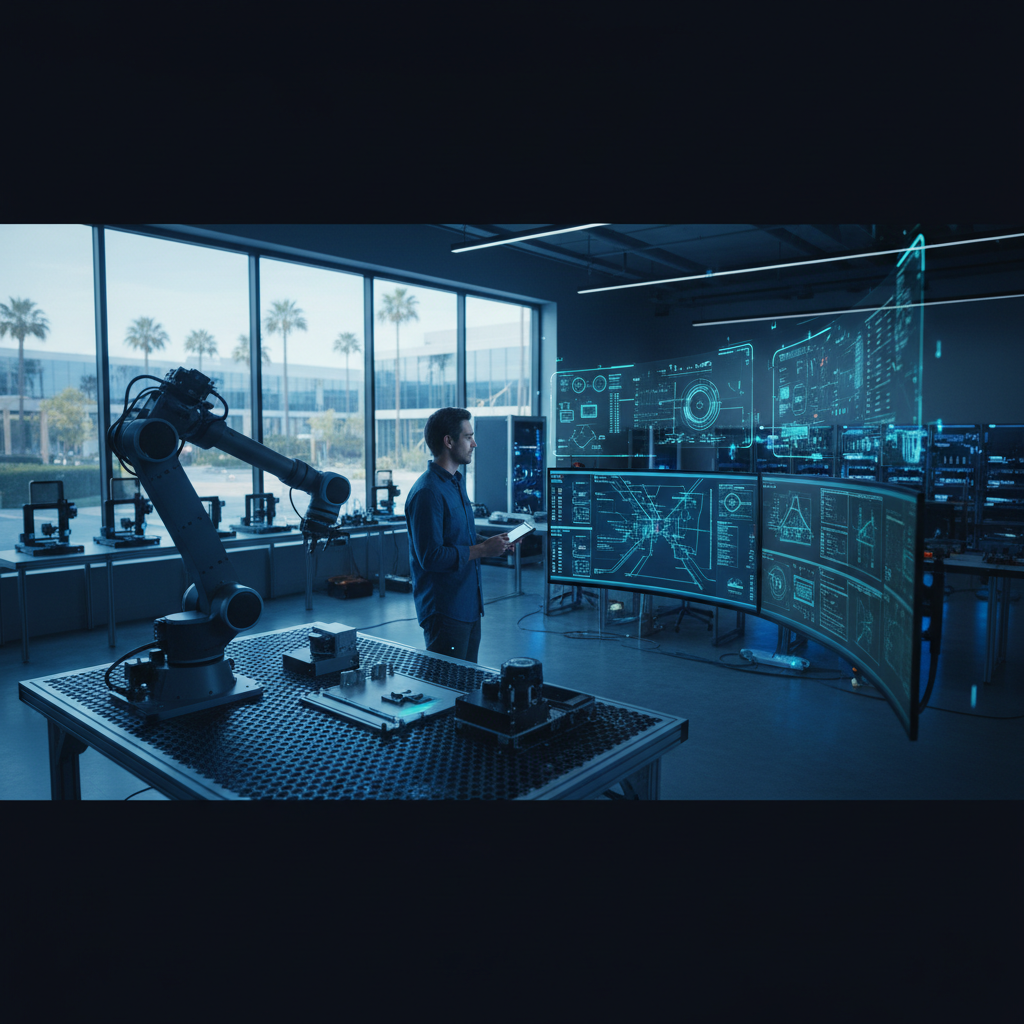
For the past decade, artificial intelligence lived behind glass. It ingested text, rendered images, analyzed tabular data, and generated code across cloud servers. While disembodied machine learning unlocked trillions in enterprise value, its operational universe remained fundamentally confined to pixels and tokens.
That boundary is disintegrating. We are entering the era of Physical AI: embodied artificial intelligence capable of perceiving dynamic environments, reasoning about physical laws, and executing physical actions in the real world. From autonomous logistics and agile manufacturing to robotic surgery and spatial computing, the frontier of innovation has shifted from screens to atoms.
For technical founders, university researchers, and engineering leaders, building in Physical AI requires an entirely different operational playbook. Code bugs in software trigger exceptions; bugs in physical AI break mechanical linkages, damage inventory, or endanger human operators. This guide breaks down the physical AI stack, exposes critical pitfalls, and provides a concrete execution framework you can deploy immediately.
Understanding the Shift from Digital to Embodied Intelligence
Digital AI models—such as large language models (LLMs)—operate within static, discrete representations. When an LLM generates a token, the external world does not exert physical resistance. Physical AI, by contrast, operates in continuous time, under immutable physical constraints like friction, inertia, gravity, and thermal limits.
Physical AI represents the convergence of three foundational technologies:
- Vision-Language-Action (VLA) Models: Extending multimodal transformers from predicting next words to outputting precise motor trajectories, joint torques, and spatial vectors.
- High-Fidelity Physics Simulation: Leveraging compute engines like NVIDIA Isaac and Omniverse to simulate decades of mechanical interactions in parallel, bridging the gap between digital simulation and real-world execution (Sim2Real).
- Edge Compute and Sensor Fusion: Co-locating high-throughput inference chips directly on autonomous hardware, fusing inputs from LiDAR, stereo vision, force sensors, and inertial measurement units (IMUs) with microsecond latency.
Founders who succeed in this space do not view themselves merely as robotics companies or software platforms. They operate as systems integrators of software, hardware, and physical dynamics.
The Three-Tier Architecture of Physical AI
To build a defensible physical AI company, you must separate your technical stack into modular layers that scale independently. A common error is building monolithic systems where high-level reasoning is coupled directly to motor drivers.
+-------------------------------------------------------------+ | Layer 1: Cognitive Planning | | Semantic reasoning, goal decomposition, world models | | Latency: 500ms - 2s (Cloud / High-Tier Edge) | +-------------------------------------------------------------+ | v +-------------------------------------------------------------+ | Layer 2: Trajectory & Perception | | Scene reconstruction, depth estimation, path planning | | Latency: 20ms - 100ms (On-Device Edge SoC) | +-------------------------------------------------------------+ | v +-------------------------------------------------------------+ | Layer 3: Real-Time Dynamic Control | | Torque calculation, balance, safety limiters, motor PID | | Latency: <1ms - 5ms (Deterministic Microcontroller) | +-------------------------------------------------------------+
1. The Cognitive Planning Layer (Slow Loop)
This tier interprets high-level objectives (e.g., "clear the unboxed inventory from workstation B and place it on shelf three"). It leverages multimodal models to parse semantic scenes, prioritize tasks, and decompose ambiguous goals into sequential physical sub-tasks. It typically runs at frequencies between 0.5 Hz and 2 Hz.
2. The Perception and Trajectory Layer (Medium Loop)
This tier translates semantic sub-tasks into collision-free geometric trajectories. It fuses camera streams, point clouds, and tactile data to track moving obstacles and estimate 6-DoF (Degrees of Freedom) poses. Operating between 10 Hz and 50 Hz, this layer reconciles discrepancies between the robot's internal world model and sensor observations.
3. The Actuation and Safety Layer (Fast Loop)
This tier translates trajectories into motor currents, hydraulic pressures, or joint torques. Running at 200 Hz to 1,000 Hz on deterministic real-time microcontrollers, it guarantees dynamic stability and reflex-level safety overrides. If a sensor fails or an obstacle suddenly obstructs the path, this layer halts motion within milliseconds, completely bypassing the cognitive planner.
Four Critical Traps Founders Face in Physical AI
Physical AI startups face failure modes that purely digital software companies never encounter. Recognizing these traps early protects your runway and sharpens your commercial roadmap.
1. The "Sim-to-Real" Mirage
Simulation is indispensable, but synthetic perfection is dangerous. Physics engines approximate contact dynamics, friction coefficients, and lighting variations. Founders often spend twelve months training models in simulation that perform flawlessly in synthetic benchmarks, only to watch them fail instantly in the presence of sunlight glare, lens dust, or minor gear backlash. Simulation must be grounded by physical telemetry from day one.
2. Premature Hardware Customization
Engineers love designing custom hardware. However, developing proprietary mechanical chassis, custom printed circuit boards (PCBs), and bespoke actuators before identifying true product-market fit drains capital rapidly. Successful founders deploy off-the-shelf industrial arms, mobile bases, and standardized sensor packages to validate control software before optimizing form factors.
3. The Web Data Assumption
Unlike natural language processing, where internet-scale data is readily accessible, high-quality physical teleoperation data does not exist in the public domain. Founders frequently underestimate the cost, operational friction, and personnel required to collect thousands of hours of high-precision manipulation data across diverse environments.
4. Overlooking Deterministic Safety
End-to-end neural networks that map camera pixels directly to actuator torques are impressive research demonstrations, but they present significant certification and commercialization hurdles. Industrial customers will not deploy systems that cannot guarantee deterministic safety boundaries. Your architecture must incorporate hard mechanical and algorithmic stops outside the neural network.
A Strategic Execution Framework: The 5-Stage Physical AI Loop
To move systematically from bench prototype to scalable industrial deployment, founders should execute across five disciplined stages.
Stage 1: Define ODD (Narrow Bounds) | Stage 2: Hybrid Data Engine (Sim + Teleoperation) | Stage 3: Decoupled Control Architecture | Stage 4: Hardware-in-the-Loop CI/CD | Stage 5: Fleet Feedback & Edge Distillation
Stage 1: Constrain the Operational Design Domain (ODD)
Never build an agent that attempts to handle "any task in any room." Define the operational environment down to precise variables: lighting tolerances (lux levels), payload weights, surface textures, and human proximity rules. Constraining the problem enables commercial viability months ahead of generalized approaches.
Stage 2: Build a Hybrid Data Collection Engine
Combine three data sources into a single ingestion pipeline:
- Synthetic Data Generation: Randomized physics simulations to teach geometric invariance.
- Teleoperation Telemetry: Humans operating rigs to demonstrate edge cases, recovery maneuvers, and complex manipulation.
- Autonomous Edge Telemetry: Deployed units flagging low-confidence events and automatically uploading sensor snapshots for active learning.
Stage 3: Decouple Software Releases from Mechanical Iteration
Establish rigid hardware abstraction layers (HAL). Your perception and planning software should communicate with actuators via standardized APIs (e.g., ROS 2, gRPC). This allows mechanical and software teams to innovate independently without breaking downstream functionality.
Stage 4: Implement Hardware-in-the-Loop Continuous Integration (HIL-CI)
Software pull requests should not simply clear unit tests. They must run automated regressions against dedicated physical test cells in your laboratory. If a software update induces micro-oscillations in an arm or delays emergency stops by 10 milliseconds, the deployment pipeline must reject it automatically.
Stage 5: Distill Large Models for Edge Inference
While you may train massive foundation models in the cloud, deployed machines must operate reliably through network disconnects. Use quantization, knowledge distillation, and tensor compiler optimizations to run inference directly on low-power edge accelerators located on the machine.
Practical Insights: What Founders Can Execute This Week
If you are running a physical AI or robotics startup today, you do not need to wait for your next financing round to de-risk your venture. Here are four tactical priorities for your team this week:
- Audit Your Failure Modes: Pull the last 50 physical test failures from your logs. Categorize them rigorously: Did the failure occur due to perception error, semantic misclassification, trajectory planning latency, or mechanical wear? Focus your sprint exclusively on the category responsible for the majority of errors.
- Establish a Sim2Real Metric: Quantify your simulation-to-reality gap. Measure the delta between simulated joint torque predictions and actual sensor-reported torques across a standardized path. Drive this error rate down before training larger policy networks.
- Define Your Shadow-Mode Infrastructure: Design an architecture that allows updated models to run passively in "shadow mode" on deployed devices. Compare their predicted actions against existing operational controllers without granting them physical actuation authority.
- Codify Hard Safety Envelopes: Ensure that every motor driver has independent current, velocity, and positional limits enforced at the firmware level, entirely isolated from your neural network layers.
Summary Checklist for Physical AI Teams
- The Operational Design Domain (ODD) is documented with explicit operational constraints.
- System architecture isolates fast deterministic control loops (<5ms) from high-level reasoning (>500ms).
- Data pipelines combine high-volume synthetic simulation with targeted real-world human teleoperation.
- Mechanical systems use commercial off-the-shelf components until core software value is validated.
- Hardware-in-the-loop continuous integration (HIL-CI) runs automated safety and regression tests on physical testbeds.
- Edge inference architecture functions safely during complete cloud and local-network disconnects.
How Synapses Ventures Can Help
Building physical AI companies demands more than conventional software venture capital. It requires an investment and venture building partner that understands the capital expenditures, supply chains, sensor procurement, hardware-software co-design, and deployment cycles native to physical technologies.
At Synapses Ventures, we partner with founders, academic researchers, and engineering innovators to turn breakthrough technological research into commercially scalable companies. Through hands-on venture building, we help teams design defensible technical architectures, navigate early supply chain partnerships, structure pilot deployments with enterprise customers, and build global networks across Silicon Valley and international industrial hubs.
Whether you are commercializing university research in multimodal robotics, designing novel spatial perception platforms, or deploying autonomous systems into industrial operations, Synapses Ventures provides the strategic guidance, capital access, and operational muscle required to bring your physical intelligence to scale.
Share this article
Building Physical AI: A Strategic Guide to Embodied Systems

Physical AI transitions machine intelligence from screen-bound reasoning to active real-world actuation.

Inside the piece:
• What actually moves the needle for early-stage founders
• How we apply it across the Synapses venture portfolio
• The practical next step you can take this week

Read the full article → https://synapsesventures.com/s/building-physical-ai-guide-for-founders

#SynapsesVentures #StartupInsights #VentureCapital #Innovation